
Informal Sector as a Safety Net for Township Economies in South Africa
Opinion Article by Mmakgantse Mmereki
When we talk about the economy, we often focus on big businesses, formal jobs and government policies. But there’s a whole other side that doesn’t get nearly enough attention – the informal sector. In countries like South Africa, this part of the economy is not just a footnote; it is a lifeline for millions. As of 2024, nearly 19.5% of employed South Africans worked in the informal sector (Stats SA, 2025). That is over 7.8 million people earning a living outside the formal economy.
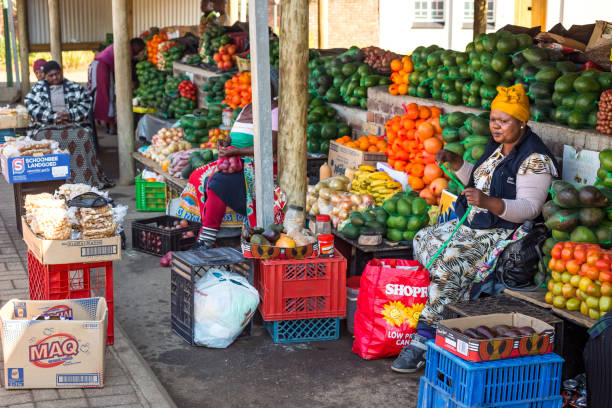
Think about the street vendors, the backyard mechanics, hair salons, caravan (magwenya & plates), beauty and make-up stalls, and the countless others who hustle every day without formal registration or regulation. These are the people who keep township economies alive. They may not show up in official stats, but their impact is undeniable. South African townships are home to about 60% of the unemployed population (World Bank, 2014) and are still shaped by the spatial and economic legacies of apartheid, and formal job opportunities are scarce. Unemployment is sky high at 32.9%, and poverty is deeply entrenched. For many informal sectors is not a choice, it is the only option. It is how families put food on the table, send kids to school and survive from one month to the next.
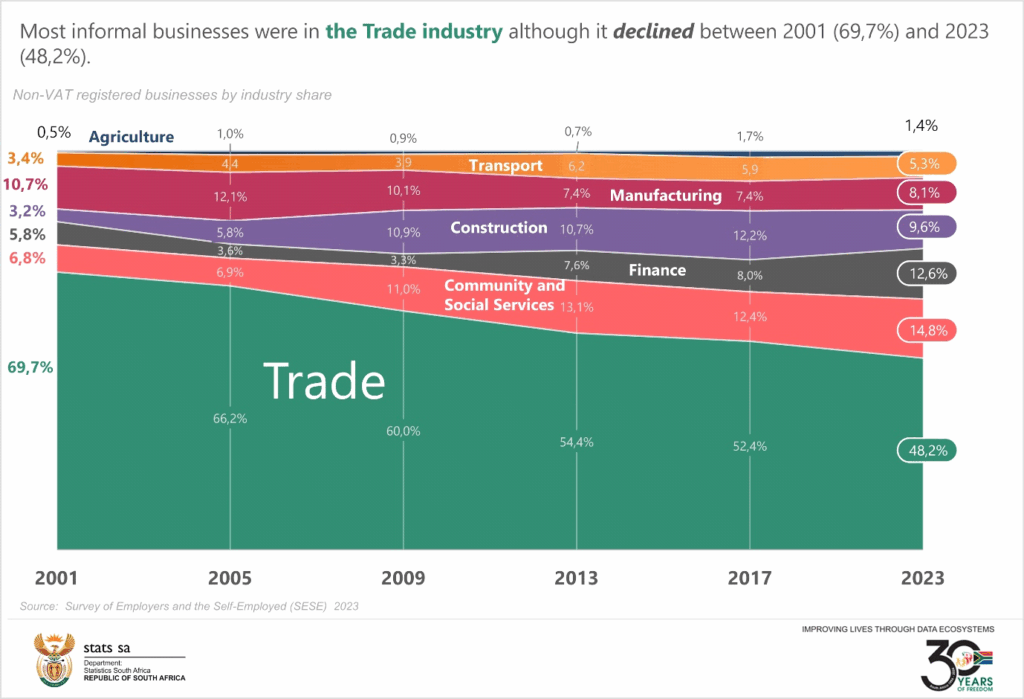
South Africa’s informal sector has mostly been about trade for a long time, but that’s starting to change. Back in 2001, about 70% of informal businesses were in trade, but by 2023, that number fell to around 48%. While trade is still the biggest part of the informal economy, other sectors like services, finance, construction, transport, and agriculture are growing. This shows that informal businesses are shifting their focus to different industries.
Yes, the work can be unstable and income unpredictable, but it is work and, in a country where formal employment is out of reach for so many, that matters. The informal sectors act as a safety net, catching those who fall through the cracks of the formal economy. The informal sector also plays a surprisingly big role in the broader economy. It contributes around 18% to South Africa’s GDP (Stats SA, 2025). That’s not pocket change—it’s a significant chunk of economic activity that helps keep the country afloat, especially in times of crisis. What’s more, this sector is a powerful tool for poverty reduction. While formal jobs still have a stronger impact on reducing poverty overall, studies show that each informal job can reduce poverty by up to 100% as effectively as a formal one, depending on the context (Ayoo, 2021; Jessen & Kluve, 2021). That’s a big deal in a country where over half the population lives below the upper-bound poverty line.
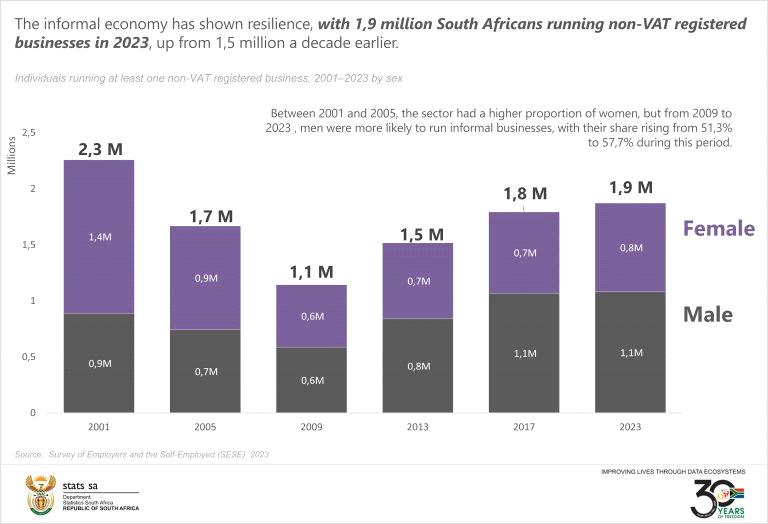
And let’s not forget the entrepreneurial spirit. In 2023, 1.9 million South Africans were running informal businesses, up from 1.5 million a decade earlier (see below Figure) (Tshuma, 2023). Many of these entrepreneurs are women and older adults who’ve been shut out of the formal job market. They’re not just surviving—they’re innovating, adapting, and building something from nothing.
Therefore, we need to stop treating this sector like a problem to be fixed and start seeing it as a powerful tool for inclusive growth. If we understand how it works, what drives it, and what challenges it faces, we can start building policies that support rather than stifle this vital part of our economy. It is time we gave the informal economy the recognition it deserves, not just a stopgap, but a cornerstone of resilience and innovation in South Africa’s economic landscape.
Mmakgantse Mmereki is an HMI Senior Fellow for Township Economy with extensive experience as an Economics Lecturer at the University of South Africa. She also holds a Masters Degree in Local Economic Development.
HMI is a Think Tank of The House Mazibuko Foundation NPC which is a Non Profit Organisation that is funded through generous donations. Please kindly click the below button to be a part of our movement.
Footnotes:
1. Ayoo, C. (2022). Poverty reduction strategies in developing countries. Rural development-education, sustainability, multifunctionality, 19.
2. Jessen, J., & Kluve, J. (2021). The effectiveness of interventions to reduce informality in low-and middle-income countries. World Development, 138, 105256.
3. Statistics South Africa. 2025. South Africa’s Informal Economy: A Lifeline for Millions. Available at https://www.statssa.gov.za/?p=18255#:~:text=According%20to%20the%20latest%20Quarterly,jobs%20after%20the%20formal%20sector.
4. Tshuma, T. 2023. Addressing poverty and unemployment in South Africa’s townships. Available at https://www.wider.unu.edu/publication/addressing-poverty-and-unemployment-south-africas-townships
5. World Bank. 2014. The Economics of South African Townships. Available at https://www.worldbank.org/en/country/southafrica/publication/the-economics-of-south-african-townships-special-focus-on-diepsloot#:~:text=Sandeep%20Mahajan,and%20improving%20public%20sector%20services

Leave A Comment