Smart Cities in South Africa: Unlocking the Future of Township Economies
Opinion Article by Mmakgantse Mmereki
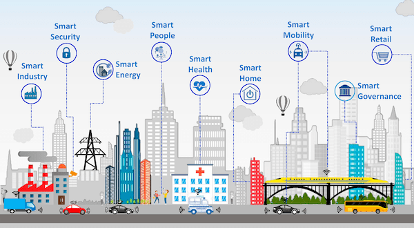
In the heart of South Africa’s vibrant townships, a revolution is brewing, one that promises to transform not just urban landscapes but the very fabric of our local economies. As global trends shift towards digital transformation and sustainable urban planning, the concept of smart cities has gained attention. This is not just about infrastructure upgrades; it’s about creating inclusive spaces that empower local communities.
What is a Smart City?
A municipality is considered a “smart city” when it utilises information and communication technology (ICT) to improve administrative efficiency, share information with the community, and elevate the quality of public services and the well-being of its citizens (Hashim, 2024). A smart city can be understood as more than just a tech-driven urban space; it is a dynamic ecosystem where digital innovation meets human and social development (Kougias & Papadakaki, 2025). At its core, a smart city leverages information and communication technologies (ICT) alongside robust community networks and responsive public institutions to foster sustainable economic growth, enhance quality of life, and manage resources efficiently. What makes this concept powerful is its multidimensional approach, which combines cutting-edge technology with social inclusion and participatory governance (Daramola, 2024). Through data-driven solutions and digital platforms, smart cities aim to address modern urban challenges, including congestion, poor service delivery, and environmental pressures, while empowering citizens to play an active role in shaping their communities (Ghaderi & Ghaderi, 2025).
Smart Cities and Township Economy
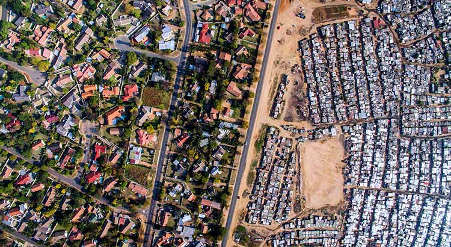
The concept of smart cities offers an exciting gateway to revitalising township economies, bridging the gap between technology and inclusive growth. For South Africa, where inequality and spatial segregation remain entrenched, smart cities offer more than just innovation; they present a real opportunity to uplift township economies and bridge historical divides. Townships, born out of apartheid spatial planning, have long been marginalised in terms of infrastructure, investment, and access to services (Schoeman, 2018). The photo below illustrates the stark contrast between overpopulated townships and nearby affluent urban areas in South Africa, highlighting the deeply entrenched socio-economic inequalities that persist in the country. Townships such as Khayelitsha and Umlazi, characterised by high population density, lower household incomes, and limited access to quality infrastructure, stand in sharp opposition to affluent urban neighbourhoods like Sandhurst in Johannesburg or the exclusive suburbs of Cape Town’s Atlantic Seaboard. These wealthy areas boast significant financial governance, luxury properties, and superior municipal services, which starkly contrast with the challenges faced by townships, including underemployment, lower property values, and inadequate service delivery.
Despite this, townships are vibrant hubs of informal trade, creativity, and resilience. Integrating townships into smart city frameworks could unlock their economic potential and foster inclusive urban development. Township economies are largely informal, with spaza shops, street vendors, beauty salons and other home-based businesses forming the backbone of local commerce. Smart city initiatives can support these enterprises by providing digital tools for inventory management, mobile banking, and customer engagement. Municipalities can also use data to understand local economic patterns and tailor support programs accordingly. Furthermore, smart logistics and transport systems can improve mobility within and between townships, making it easier for entrepreneurs to access suppliers and customers. Imagine a township where delivery drones or electric tuk-tuks efficiently transport goods, or where real-time traffic data helps informal traders plan their routes.
As we stand on the brink of this transformation, we must ask ourselves: Are we ready to embrace this opportunity and drive real change in our townships?
Mmakgantse Mmereki is an HMI Senior Fellow for Township Economy with extensive experience as an Economics Lecturer at the University of South Africa. She also holds a Masters Degree in Local Economic Development.
HMI is a Think Tank of The House Mazibuko Foundation NPC which is a Non Profit Organisation that is funded through generous donations. Please kindly click the below button to be a part of our movement.
Reference
- Hashim, H. (2024). E-government impact on developing smart cities initiative in Saudi Arabia: Opportunities & challenges. Alexandria Engineering Journal, 96, 124-131.
- Daramola, O. J. (2024). Building Sustainable and Inclusive Smart Cities.
- Ghaderi, Y., & Ghaderi, M. R. (2025). Harnessing Digital Technologies for Integrated Urban Planning and Urban Management: Toward Smart, Resilient Cities. Digital Technologies Research and Applications, 4(3), 33-50..
- Kougias, C., & Papadakaki, M. (2025). Rethinking the ‘smart city’: From technology-led visions to citizen-centered governance—barriers and pathways in digital urban initiatives. Journal of Urban Affairs, 1-24.
- Schoeman, T. (2018). The spatial influence of apartheid on the South African city. The Geography Teacher, 15(1), 29-32.



Leave A Comment